Thursday, 29 March 2012

Thursday, 22 March 2012
Evaluation
Question 1.
In what ways does our media product use, develop or challenge forms and conventions of real media products?
 Image 1 illustrates the location of the opening sequence. We decided to use a wide shot to establish the location of the forest. We chose to use a forest for the first shot because it is a typical convention of a horror film as many horror films have some kind of element addressed in the forest. Severance is an example.
The character is introduced though different camera shots. She was not given any dialogue because the character does not have much of a profile at the opening sequence. This is to build up tension about what kind of person is she, how will she deal with the fact see if being followed, we wanted to build up the suspense. As all the screen time is on her it's obvious to see that she is the main character.
The most obvious convention on our opening sequence is the colours and fonts of the credits though out the opening sequence. As image 3 illustrates our colours are red, white and black. In my planning and research I planned to use black and red because it is a typical convention that will easily show the audience the genre, horror. These images of the Grudge and Decent illustrate that red and black are popular colours for a horror genre.
Image 7 illustrates the camera work. The shot has captured the victim and the killer’s arms and hands only. This is to keep his identity a secret. This image of Halloween also illustartes use of specific camera shots to capture the victim and the murderer but still keep the identity of the murderer a secret.
Image 8 illustrates the title font style and colour of the opening sequence. As discussed above the colours red and black are used because they are typical conventions of a horror film. The font is also quite typical of a horror film, because it’s elongated and the edges aren’t smooth. This particular font used by the editor Josh was included because it looks as though there is blood dripping from the letters. This helps keeps the genre running though the opening sequence.
The camera shot used at the end is an extreme close up. This was used to show the facial expression of the victim as she is frightened. As I completed my planning and research, I found this was a very common camera shot used, so I made sure that it was included into the opening sequence. The ring is another horror film that illustrates the close up to show the expression of fear on the characters face.
Question 2.
How does your media product represent particular social groups?

In the terms of costume, there is a little bit of difference but this is more likely due to the time difference of when they were filmed. The character in Halloween, left, is dressed quite casual, as they are on their way home from college. However the character in my opening sequence is on her way home from a party, therefore she is dressed up a little more. The fact that my character is on her way home in the dark from a party could represent a typical student from the Essex area, this is because they carry a stereotypical representation of ‘party animals’.
The body they have at this point it quite relaxed, this is because they both don’t know they are being followed so there’s no body language suggesting fear or anxiety.
The role they both play in the film is the young, vulnerable college student. They are the main victim to the attacker. There are scenes where the camera just follows them, this is because they are the main characters and to give the audience an idea that something will happen to them.
The character in the sequence I filmed the character does not have any dialogue. This is because the attacker has got them alone. The opening sequence is not giving too much away about her personality or character. However the character in Halloween does have dialogue, as she has been introduced more in the sequence.
With the shots that were used you cannot see how much make up they have on. However the character on the left does not wear that much make up, it is quite subtle. However the character on the right has a reasonable amount of make up on, it’s neither overloaded nor subtle. This could also make the character on the right conform to the typical Essex teenager, as many students form Essex carry a stereotypical representation of wearing a lot of make-up.
The character on the left is carrying books and a bag. This is because she has been to college therefore she is carrying all her college work. This is a stereotypical representation of a good American student. However the character on the right is not carrying books, or have any indication that she goes to college. She is just carrying a bag, probably filled with the typical content of a young girl from Essex, make-up, hairbrush, clothes ect. She also is wearing a pair of headphones, this shows she is consumed in her own world and wouldn’t notice what’s going on in her surroundings. Many typical teenagers wear headphones and listen to music to block out the surroundings and this character conforms to this idea.
Question 3.
What kind of media institution might distribute your product and why?
To be able to distribute a film, you will need a distributer. A distributer is someone that distributes a film. Without a distributer the film would not be released. Their role is to attract a wide audience for it to be successful and profitable.
All The Boys Love Mandy Lane is quite similar to my product. This is because the victims are both young females subjected to males horrific actions.
Optimum Releasing was the UK Theatrical company that distributed the film.


 The posters are all examples of films that are distributed by Optimum Releasing. They are obviously of the same genre of mine, I can see this though the key conventions of a horror that are placed within the posters.
Question 4.
Who would be the audience for your media product?

Question 5.
How did you attract/adress your audience?
Question 6.
What have you learnt about the technologies from the process of constructing this product?
Our media coursework had to be uploaded to a blogging website, Blogger. I had never used a blogging website before so this was new. However I soon got to learn how to use it. I learnt how to make and post a blog, add pictures, add links/URLS, view other people’s blogs and encode a video. I can now confidently use Blogger.
I also learnt how to use Scribd, this is a website you can upload a document e.g. PowerPoint to and it then allows you to encode it, and with that encoding you can put it onto the blog. I used Scribd during planning and research.
Another website I learnt to use was Prezi, I used this website to help answer question 3 in the evaluation. I used this so that my evaluation was more interactive.
As I was the cameraman I got to use the sony HVR-V1U pro HDV 1080p camera a lot, therefore I had to learn how to use it because I had never used a camera like that before. I got used to the different buttons and what they used for, I learnt how to zoom in and out smoothly however this was not used during filming. I also learnt how to use the microphone, hold it properly and move it around correctly to capture a good shot when it wasn’t on the tripod. During filming the tripod was used, once again I had never used this before so I had to learn how to use it. I learnt how to adjust the height, connect the camera to it securely and move it around while it was on the tripod to capture good shots.
To edit the footage in postproduction, Final Cut Pro was used, once again I had never used this software before so Josh the editor tried to teach me how to use it as I overlooked him editing. I found it quite hard and confusing at first. However I did learn how to adjust the lighting and colour correlation, add titles and edit them and add a soundtrack. However the time line confused me a little I could get to grips with all the moving it around to cut parts out and move different clips closer together.
I have always used You Tube and I have uploaded videos before however I had never edited a video clip by adding speech bubbles. I learnt how to do this so I could answer question 5 in the evaluation.

Question 7.
Looking back at your preliminary task, what do you feel you have learnt in progression from it to the full product?
The thing I’ve learnt the most would be how to get the camera into position quickly, in the preliminary task I would take a while positioning myself and the camera to make sure I was in the correct position, however during the filming I learnt where about the camera and I needed to be when doing particular shots, this finished the filming process a lot quicker.
I have learnt how to edit a clip, during the editing of the preliminary task I didn’t do any editing, however during the actual opening sequence I done some because I had learnt how to use it, even though I found it tricky to get the hang of. I learnt to adjust the lighting and colour correlation, add titles and edit them and add a soundtrack. I didn’t edit or trim the shots, this is because when I tried to learn how to do it I couldn’t pick it up, even though it was Josh task, as the editor, I still wanted to contribute to the editing.
With the preliminary task I feel as though the background music we picked was not relevant to the filming or task, we could have picked a better, softer soundtrack that let the focus be on the actual filming rather than the overpowering music. For the final product I feel as though we managed to add a suitable soundtrack to the filming.
During the final filming I learnt how to do different shot types that the preliminary task didn’t cover such as:
Wide Shot – (0.05 – 0.09) (0.42 – 0.50)
Tracking - (0.15 - 0.20)
Extreme Close Up – (1.24 – 1.25)
For the preliminary task we didn’t plan what to do in advance, we only had a rough outline. We didn’t use a story board or script, therefore the preliminary task was quite improvised. However for the final product we used a story board and a script. Even though we didn’t stick to the story board and made a few changes, this still gave us a good idea of what we wanted out product to look like. This helped our final product production flow quite smoothly compared to the preliminary task that wasn’t so well planned.
In what ways does our media product use, develop or challenge forms and conventions of real media products?
 |
| Severance |
You can see that the camera angle and shot in our opening sequence and severance is similar, as the audience can see the front of the characters with the forest behind them, the effect this gives is establishing the location and giving the first clue to it being a horror.
The character is introduced though different camera shots. She was not given any dialogue because the character does not have much of a profile at the opening sequence. This is to build up tension about what kind of person is she, how will she deal with the fact see if being followed, we wanted to build up the suspense. As all the screen time is on her it's obvious to see that she is the main character.
The most obvious convention on our opening sequence is the colours and fonts of the credits though out the opening sequence. As image 3 illustrates our colours are red, white and black. In my planning and research I planned to use black and red because it is a typical convention that will easily show the audience the genre, horror. These images of the Grudge and Decent illustrate that red and black are popular colours for a horror genre.
 |
| The Grude Poster |
 |
| Decent Poster |
Image 4 illustrates the editing that Josh done for the opening sequence. He has used an animaiton that crossed over the credits and this was in fast speed. He done this to give effect to the tension that is being built up, as other credits were introducted slowly at the begining when there was less suspense.
Image 5 illustrates the colour correction that was used in post-production. The colour was edited to be darker because when we actually filmed the scene it was broad day light however the opening sequence was supposed to be set in the evening. So this was the only way to give it a dark tone.
The shot used in image 6 is used so the audience can see her costume. She is wearing a dress as she has been to a party. This is a typical representation of a young female that is a vulnerable victim. She is using headphones as she listens to music, this represents her youth and many youngsters have headphones to block out the surroundings.
Image 7 illustrates the camera work. The shot has captured the victim and the killer’s arms and hands only. This is to keep his identity a secret. This image of Halloween also illustartes use of specific camera shots to capture the victim and the murderer but still keep the identity of the murderer a secret.
 |
| Image taken from Halloween |
The camera shot used at the end is an extreme close up. This was used to show the facial expression of the victim as she is frightened. As I completed my planning and research, I found this was a very common camera shot used, so I made sure that it was included into the opening sequence. The ring is another horror film that illustrates the close up to show the expression of fear on the characters face.
Question 2.
How does your media product represent particular social groups?

In the terms of costume, there is a little bit of difference but this is more likely due to the time difference of when they were filmed. The character in Halloween, left, is dressed quite casual, as they are on their way home from college. However the character in my opening sequence is on her way home from a party, therefore she is dressed up a little more. The fact that my character is on her way home in the dark from a party could represent a typical student from the Essex area, this is because they carry a stereotypical representation of ‘party animals’.
The body they have at this point it quite relaxed, this is because they both don’t know they are being followed so there’s no body language suggesting fear or anxiety.
The role they both play in the film is the young, vulnerable college student. They are the main victim to the attacker. There are scenes where the camera just follows them, this is because they are the main characters and to give the audience an idea that something will happen to them.
The character in the sequence I filmed the character does not have any dialogue. This is because the attacker has got them alone. The opening sequence is not giving too much away about her personality or character. However the character in Halloween does have dialogue, as she has been introduced more in the sequence.
With the shots that were used you cannot see how much make up they have on. However the character on the left does not wear that much make up, it is quite subtle. However the character on the right has a reasonable amount of make up on, it’s neither overloaded nor subtle. This could also make the character on the right conform to the typical Essex teenager, as many students form Essex carry a stereotypical representation of wearing a lot of make-up.
The character on the left is carrying books and a bag. This is because she has been to college therefore she is carrying all her college work. This is a stereotypical representation of a good American student. However the character on the right is not carrying books, or have any indication that she goes to college. She is just carrying a bag, probably filled with the typical content of a young girl from Essex, make-up, hairbrush, clothes ect. She also is wearing a pair of headphones, this shows she is consumed in her own world and wouldn’t notice what’s going on in her surroundings. Many typical teenagers wear headphones and listen to music to block out the surroundings and this character conforms to this idea.
Question 3.
What kind of media institution might distribute your product and why?
To be able to distribute a film, you will need a distributer. A distributer is someone that distributes a film. Without a distributer the film would not be released. Their role is to attract a wide audience for it to be successful and profitable.
All The Boys Love Mandy Lane is quite similar to my product. This is because the victims are both young females subjected to males horrific actions.
Optimum Releasing was the UK Theatrical company that distributed the film.


Question 4.
Who would be the audience for your media product?
I filmed a few people that fit my target audience of 16 – 25. I asked them these questions:
· What’s your name
· How old are you
· What other films do they like?
· What types of music are they into?
· What magazines do they read?
· What are their favourite TV shows?
· What websites do they visit?
· Do they play console games? If so which ones?
· What phone do they have?... any other gadgets?
· What do they do at the weekend?
· What do they spend their money on?
I uploaded this one video to show my research. Below is a mood board of all the likes and interests of my target audience. As you can see they are very different, this means my target audience aren’t necessarily the same type of people who enjoy the same type of things, however they do all share a common interest of horror films.
Some of the answers my target audience gave me for the question ‘what type of music are they into?’ were, hip-hop, rock, grime and r&b.
Some responses for ‘what do you do on the weekend?’ were shopping, travelling, going to skate parks and socialising with friends.
From these results I concluded that my target audience were very different from one another, therefore I would have to distribute my product widely and to attract a wide audience.

Question 5.
How did you attract/adress your audience?
Question 6.
What have you learnt about the technologies from the process of constructing this product?
Our media coursework had to be uploaded to a blogging website, Blogger. I had never used a blogging website before so this was new. However I soon got to learn how to use it. I learnt how to make and post a blog, add pictures, add links/URLS, view other people’s blogs and encode a video. I can now confidently use Blogger.
I also learnt how to use Scribd, this is a website you can upload a document e.g. PowerPoint to and it then allows you to encode it, and with that encoding you can put it onto the blog. I used Scribd during planning and research.
Another website I learnt to use was Prezi, I used this website to help answer question 3 in the evaluation. I used this so that my evaluation was more interactive.
As I was the cameraman I got to use the sony HVR-V1U pro HDV 1080p camera a lot, therefore I had to learn how to use it because I had never used a camera like that before. I got used to the different buttons and what they used for, I learnt how to zoom in and out smoothly however this was not used during filming. I also learnt how to use the microphone, hold it properly and move it around correctly to capture a good shot when it wasn’t on the tripod. During filming the tripod was used, once again I had never used this before so I had to learn how to use it. I learnt how to adjust the height, connect the camera to it securely and move it around while it was on the tripod to capture good shots.
To edit the footage in postproduction, Final Cut Pro was used, once again I had never used this software before so Josh the editor tried to teach me how to use it as I overlooked him editing. I found it quite hard and confusing at first. However I did learn how to adjust the lighting and colour correlation, add titles and edit them and add a soundtrack. However the time line confused me a little I could get to grips with all the moving it around to cut parts out and move different clips closer together.
I have always used You Tube and I have uploaded videos before however I had never edited a video clip by adding speech bubbles. I learnt how to do this so I could answer question 5 in the evaluation.

Question 7.
Looking back at your preliminary task, what do you feel you have learnt in progression from it to the full product?
The thing I’ve learnt the most would be how to get the camera into position quickly, in the preliminary task I would take a while positioning myself and the camera to make sure I was in the correct position, however during the filming I learnt where about the camera and I needed to be when doing particular shots, this finished the filming process a lot quicker.
I have learnt how to edit a clip, during the editing of the preliminary task I didn’t do any editing, however during the actual opening sequence I done some because I had learnt how to use it, even though I found it tricky to get the hang of. I learnt to adjust the lighting and colour correlation, add titles and edit them and add a soundtrack. I didn’t edit or trim the shots, this is because when I tried to learn how to do it I couldn’t pick it up, even though it was Josh task, as the editor, I still wanted to contribute to the editing.
With the preliminary task I feel as though the background music we picked was not relevant to the filming or task, we could have picked a better, softer soundtrack that let the focus be on the actual filming rather than the overpowering music. For the final product I feel as though we managed to add a suitable soundtrack to the filming.
During the final filming I learnt how to do different shot types that the preliminary task didn’t cover such as:
Wide Shot – (0.05 – 0.09) (0.42 – 0.50)
Tracking - (0.15 - 0.20)
Extreme Close Up – (1.24 – 1.25)
For the preliminary task we didn’t plan what to do in advance, we only had a rough outline. We didn’t use a story board or script, therefore the preliminary task was quite improvised. However for the final product we used a story board and a script. Even though we didn’t stick to the story board and made a few changes, this still gave us a good idea of what we wanted out product to look like. This helped our final product production flow quite smoothly compared to the preliminary task that wasn’t so well planned.
Tuesday, 20 March 2012
Proof of Editing
These screen shots are taken during the editing process, which was completed by Josh.


Tuesday, 13 March 2012
Images of Proof
On Tuesday 21st February, we came together as a group and filmed the first half to our opening sequence. I think we came together as a group very well.


These images were taken on Tuesday 6th March when we filmed the second half of the sequence.


These images were taken on Tuesday 6th March when we filmed the second half of the sequence.
Wednesday, 29 February 2012
Preliminary Task
This what the preliminary task had to include:
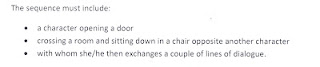

We tried our best to include these to a good standard. As the camera man I tried to make sure that the camera shots were added correctly.


We tried our best to include these to a good standard. As the camera man I tried to make sure that the camera shots were added correctly.
Preliminary Task
This was the preliminary task that we filmed and edited on Tuesday 21st February. I filmed it myself as I am the camera man, and Takura edited it because Josh was unavailable at that date to participate. Takura also took on his own role as the director. This task was to help us become familiar with the camera, different types of shots, the editing and working successfully within the group.
Monday, 13 February 2012
Eqiupment List
Takura and I came together to discuss the equipment list and got images to illustrate what we will need throughout production. Some of the equipment is to help film to the sequence and some are props, such as phone and headphones that will be used as props during filming.
 |
| Sony HVR-V1U pro HDV 1080p |
 |
| Phone |
 |
| Glidecam |
 |
| Tripod |
 |
8mm Hi8 120min Video Camera Cassette Tape |
 |
| Headphones |
 |
| Long black gloves |
Brainstorm
 |
| Takura created this brainstorm, we will follow this through production. This will help us be more organised and have ideas all in one place. |
Story Ideas
Josh, Takura and I all made individual story ideas then came together to discuss them. These photos is proof for our ideas.
Takura's


Josh's

Mine (Sophie)

Sunday, 12 February 2012
Shot List
This shot list was created by the editor. Josh.
There was a slight problem that I had done my story board before Josh had completed the shot list, therefore my story board does not include some of the same information as this shot list. However we had discussed the shot types before hand and we knew what shots I would include.
There was a slight problem that I had done my story board before Josh had completed the shot list, therefore my story board does not include some of the same information as this shot list. However we had discussed the shot types before hand and we knew what shots I would include.
LOCATION | SCENE# | SHOT | CAMERA POV | ACTION/DIALOGUE |
| Ext. Woodland in Gidea Park | # 1 | Wide Shot of girl walking into the woods (Front View) | Audience Point of view | She walks down a lane nodding alongside the loud music. *A Non-diegetic soundtrack of the musician will be heard by the audience |
| | | Medium Close up shot to show her go past a certain point. (side view) | Audience point of view | As she passes through this point, a figure moves quickly directly in front of the camera. Then the soundtrack goes a bit quiet, replaced by quick shuffling of leaves. (Demonstrating that she had paused the music for a bit). |
| | | Close up shot of the girl’s face prying into the woods. Camera stays behind a couple of leaves. | Audience point of view | She plays back the music and yet again the audience can hear the non-diegetic soundtrack, then she walks off quickly , constantly looking over her shoulder |
| | | Wide shot to show her turn into her street lane | Audience point of view | She does a few skips and seems excited about something, maybe a message on her phone. |
| Shadow Street in Gidea Park | # 2 | Close up shot of the road path ahead | Audience point of view | The killer is moving down the same path the girl took. The audience can hear very deep breathing. He moves in quick successive strides. |
| | | Medium close up shot of girl (back view) | Audience point of view | The girl is about getting to her gate. |
| | | Medium shot of girl turn back swiftly, then a quick pan to show side of a car at a low-angle. | Audience point of view | Killer disappears behind parked cars. The cameraman also does the same. |
| | | Close up shot of the girl | Audience point of view | She looks around her expecting to see someone. But then she becomes scared and shows it in her face. She then turns around and walks very fast to her house. |
| | | Close up shot of the road path | Audience point of view | Killer moves very quickly, breathing heavily. |
| | | Extreme close up shot to show the killer’s hands | Audience point of view | The killer moves after her very quickly catching up to her as she is scrambling for her house keys |
| | | Close up shot of her hands shaking out of her bag and holding on to her keys. Then a further pan to show her try to fit keys in the door | Audience point of view | She shakily brings out her keys and tries to make them fit into the door. |
| | | Close up shot to show her (back view) | Audience point of view | The killer has caught up with her and moves quickly to her |
| | | Medium shot to show her being dragged from the front steps. The camera only shows her face on the killer’s chest with his hand around her mouth. | Audience point of view | The girl is trying to scream and trying to fight him off but he’s too strong for her |
| Int. Bedroom | #3 | Extreme close up shot zooming out of her face | Audience point of view | She wakes up from a dream with her mouth open in scared gasps. The sound of an alarm goes off at the same time. Loud. |


Script

Takura the director of the group made the script, however it was a non dialouge script as we have chosen to have no dialouge in our opening sequence.
Saturday, 11 February 2012
Location


Subscribe to:
Comments (Atom)